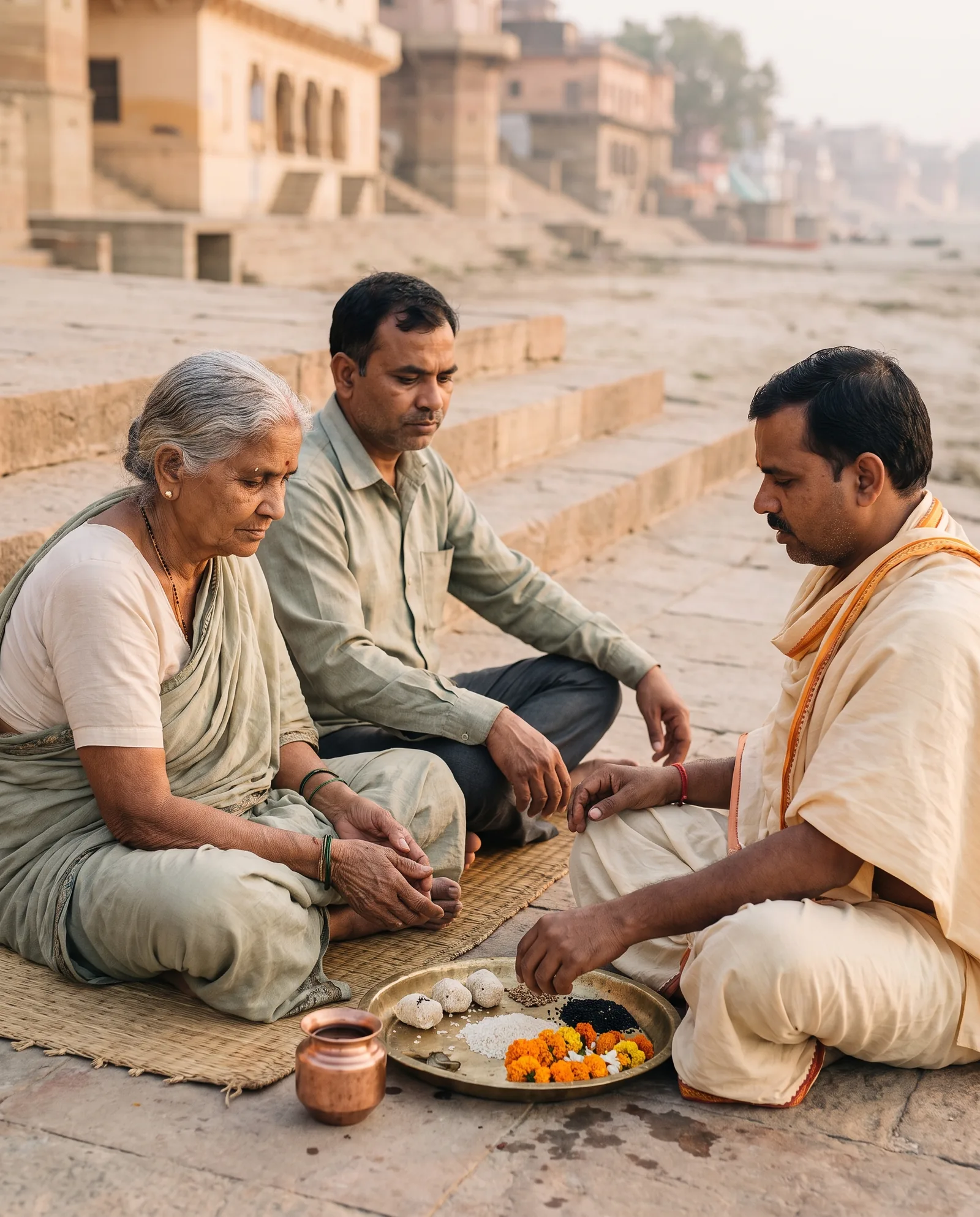
Quick answer: Pind Daan is an ancestral offering observed in many Hindu traditions. It involves offering pindas, often made with rice, in remembrance of departed family members. Families seek peace for their ancestors through the observance; the materials and sequence vary by tradition.
An offering of remembrance
For many families, Pind Daan is a way to remember those who came before them and continue a tradition of care across generations. Its spiritual meaning is understood through faith and family practice.
You do not need to arrive knowing the mantras or every step. A conversation with your family priest or chosen Pandit helps establish the appropriate observance and what you should prepare.
Pind Daan, Shraddha and Tarpan: how they relate
These terms are closely connected, but they describe different aspects of ancestral observance. The relationship below is a broad introduction; your family’s usage and practices may differ.
Swipe the table to see every column.
| Term | A simple explanation | What to discuss |
|---|---|---|
| Pind Daan | The offering of pindas in remembrance of ancestors. | Materials, participants, ritual sequence and location. |
| Shraddha | A broader ancestral observance that may include offerings and other family practices. | The appropriate tithi and the customs followed by your family. |
| Tarpan | An offering of water, associated with remembrance and prayer in ancestral observances. | When it belongs in your ritual and how you will be guided. |
What might the observance involve?
The exact sequence should be explained by your Pandit. A family visit commonly includes a discussion of intention, preparation, guided offerings and a conclusion according to the agreed tradition.
Share your family intention
Explain whom you wish to remember and any guidance already received from your family priest.
Agree on the preparation
Ask about family details, clothing, materials and observances before the ritual.
Follow the guided offerings
Your Pandit explains the sankalpa, offerings and recitations appropriate to the ceremony.
Conclude with clarity
Confirm any associated daan, dakshina or bhojan and ask about practices to follow afterward.
Your family’s custom comes first
Questions about who participates, how names are recited and what to do when a detail is unknown are best discussed before the visit. Do not guess a gotra or tithi just to complete a form.
Who will participate?
Share the relationships of those attending and any guidance from your family priest. Ask how each person can take part.
Unsure of a family detail?
Say what you know and what is uncertain. Your Pandit can explain how your tradition handles missing information.
Where might your family plan the ritual?
Gaya, Kashi and Prayagraj are destinations families consider for ancestral observances. The choice should account for your tradition, the ritual you intend and the practical needs of those travelling.
Gaya
Vishnupad Temple is a major site associated with Pind Daan. Understand the local sites and what an agreed ritual route may involve.
Explore Pind Daan in GayaKashi & Prayagraj
Discuss your family’s intention and the appropriate riverside arrangements. A familiar destination is not a substitute for confirming the ritual itself.
Plan a Kashi visitLocation reference: Bihar Tourism — Vishnupad Temple.
When should you begin planning?
Families may discuss ancestral observances around a death-anniversary tithi, Pitru Paksha or other occasions recognised in their tradition. The date relevant to your family should be confirmed with your Pandit before you book travel.
Planning for Pitru Paksha? Use the annual guide to understand the calendar, then confirm your family’s observance and the local arrangements.
Read the Pitru Paksha 2026 guideA useful first conversation
- Explain your family’s intention and the tradition you already follow.
- Share ancestor names and relationships, and gotra or tithi if known.
- Discuss who will attend, language preferences and travel needs.
- Ask which materials are provided and what you should bring.
- Agree on the ritual scope, location and written costs before confirming.
A clear explanation matters more than an impressive package label. Ask for details you can understand and keep a written record of the arrangement.
Questions families often ask
Is Pind Daan the same as Tarpan?
They are related ancestral observances, but the terms are not identical. Pind Daan refers to offerings of pindas; Tarpan refers to water offerings. Ask how both fit into your family’s planned ritual.
Do I need to know the Sanskrit mantras?
You can ask your Pandit to guide the recitations and explain the steps in a language you understand. Discuss this before the ceremony.
What if I do not know my gotra or the exact tithi?
Tell your Pandit which details are unknown. Ask how the observance should be arranged according to your family’s tradition rather than supplying a guessed answer.
Is Gaya compulsory for every family?
The appropriate place depends on family tradition and the observance being planned. Gaya has a strong association with Pind Daan, but a general guide cannot determine one location for every family.
Does a higher-priced arrangement have greater spiritual value?
A price describes services and inclusions, not a measurable spiritual result. Compare the ritual scope, materials, travel support and written terms.
Can I arrange an observance remotely?
Ask whether your tradition permits the proposed arrangement and whether a provider offers it. Confirm participation, communication and what will actually be performed before agreeing.
About this introduction
This guide explains broad concepts. Local and family practices vary. It draws on the destination context from Bihar Tourism and the Gaya District pilgrimage portal; ritual-specific decisions should be discussed with your family priest.